
Last updated November 15, 2026
 Wrought iron
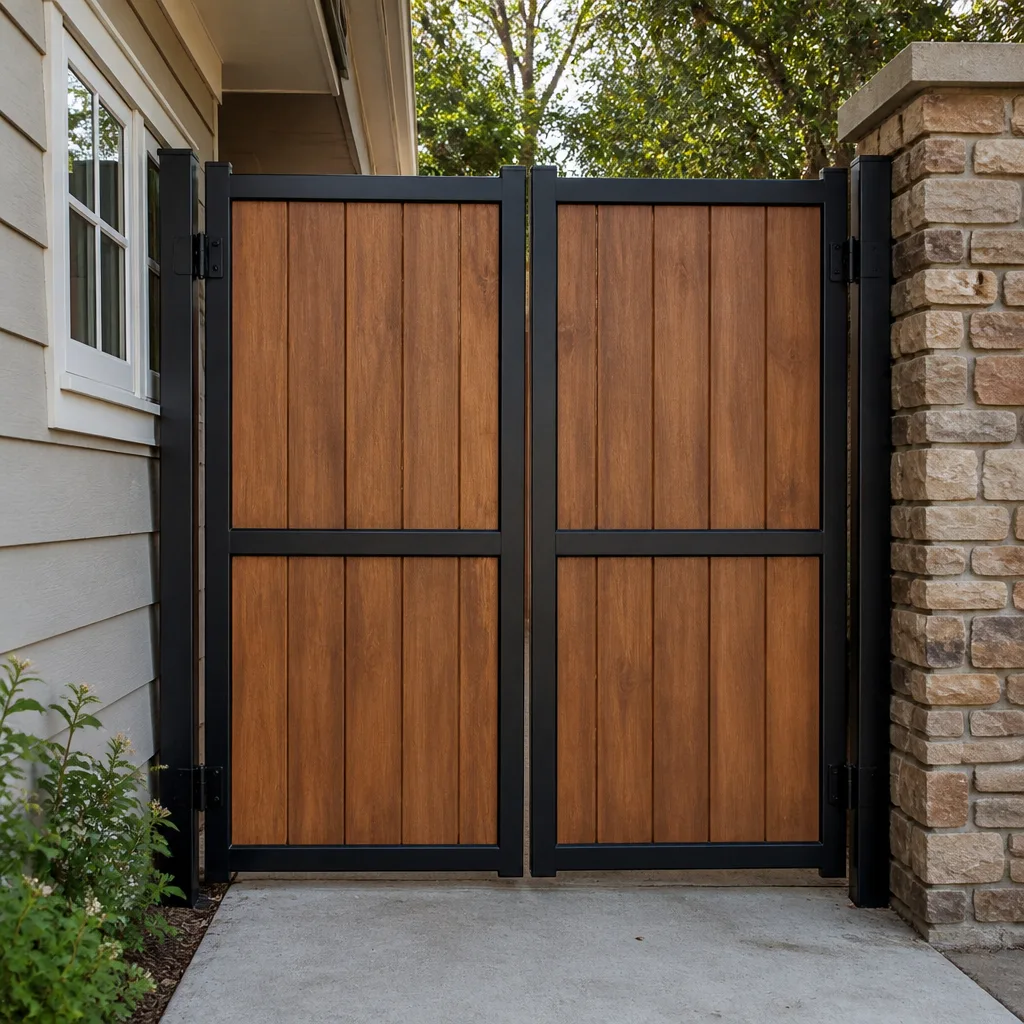 Wood & steel frame
 Farm & ranch
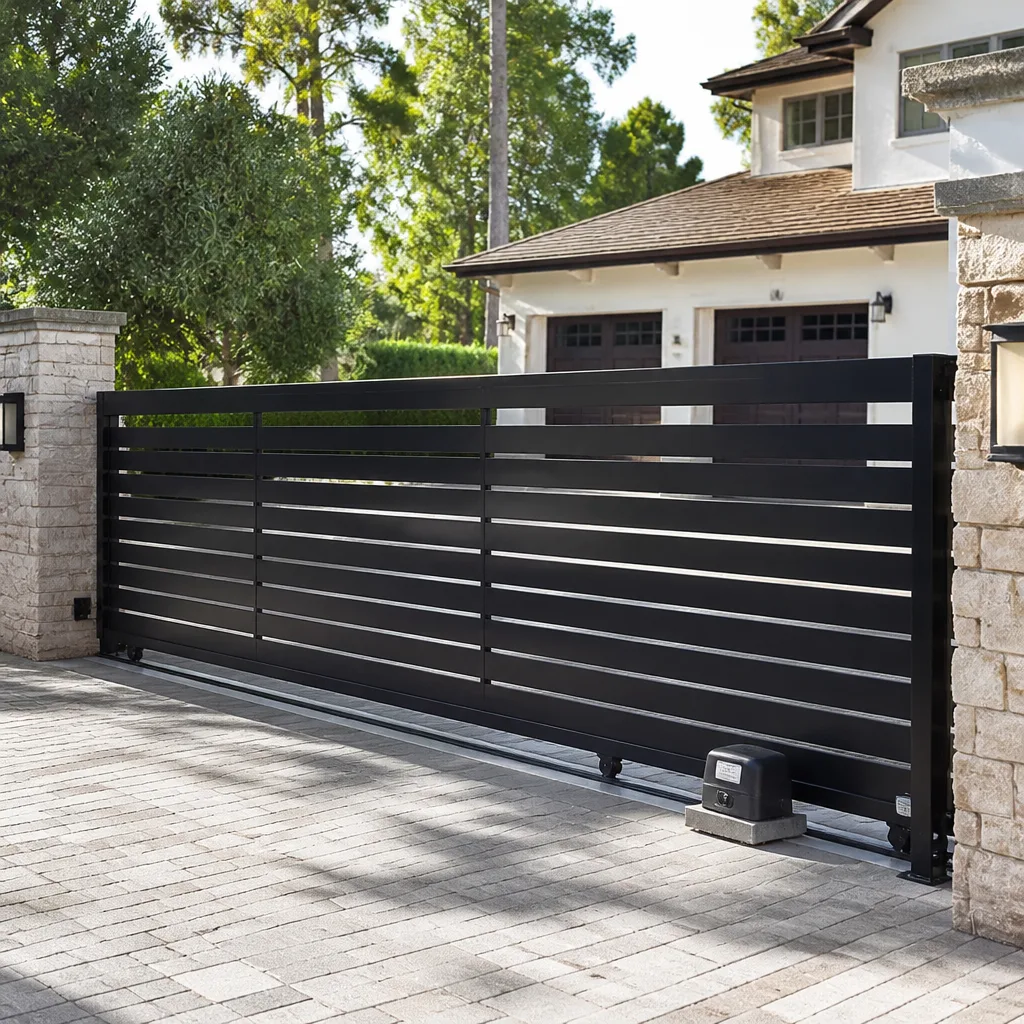 Sliding driveway gates
 LiftMaster operators
Free on-site gate assessment - hinges, posts, and your LiftMaster or Nice gate operator checked before anything is quoted
The assessment is free and the quote is the invoice.
Get your free estimateGate Repair Maintenance Checklist for Tracy Homeowners
Putting standard chain lube on a hydraulic gate operator doesn’t maintain it. It slowly ruins the seals. The oil carries grit into places the hydraulic fluid is supposed to stay clean, and over a year and a half or so the operator starts leaking and losing pressure. That’s one of the most common ways a good gate system gets talked into an early grave. Because the truth is, most gate failures in Tracy don’t come from bad equipment. They come from a maintenance routine built for a different machine. A swing arm, a sliding gate, a barrier arm, a hydraulic FAAC versus a chain-driven LiftMaster – each one has its own service points and its own interval. This guide lays out the checklist by system type, not by season, so you inspect the right things on the right schedule.
Quick Answer
A gate maintenance checklist for Tracy homeowners should be organized by operator type – swing, slide, or barrier arm – not by a generic to-do list. Each system needs different service points: swing gates need hinge and arm geometry checks, slide gates need track and roller inspection, and barrier arms need balance and impact testing. Every electric gate, regardless of type, needs monthly safety edge and loop detector testing, and manufacturer-specified lubrication matched to its brand and drive mechanism.
Styles & brands we work with
- Wrought iron
- Wood & steel frame
- Farm & ranch
- Sliding driveway gates
- LiftMaster operators
Table of Contents
- Why System-Specific Maintenance Matters
- Swing Gate Operator Checklist
- Slide Gate Operator Checklist
- Barrier Arm System Checklist
- Torque and Tension Checks for Tracy’s Temperature Swings
- Safety Edge and Loop Detector Testing
- Lubrication by Brand and Drive Type
- How to Log Maintenance for Faster Diagnosis
Why System-Specific Maintenance Matters
A gate system is a mechanical assembly with moving parts under load, and every design distributes that load differently. A swing gate operator pushes a hinged leaf through an arc, and the arm geometry has to stay precise or the motor fights itself on every cycle. A slide gate operator pulls a heavy gate along a fixed track, so roller condition and track alignment carry the load. A barrier arm operator lifts a light arm through 90 degrees, which puts the stress on a balance spring and a pivot bearing rather than a heavy driveway gate.
Treat all three the same and you’ll spend time on parts that don’t matter while the parts that do fail go untouched. We work on systems built for entry-level residential use, like Mighty Mule, and on commercial-grade European operators like FAAC and BFT, and the inspection points differ even within the same brand family.
There’s a second reason to organize by system type. A gate on a residential driveway in Tracy might cycle a few dozen times a day. A gate at the entrance to an industrial property near the Interstate 205 corridor can cycle hundreds of times a day. Cycle count drives wear, and the manufacturer’s service interval is calibrated to it. Matching the checklist to the operator type and its duty rating is how maintenance stays honest.
If you’ve been running a general seasonal checklist and something still feels off, our gate repair page covers what a diagnostic visit looks like when the gate has already stopped working correctly.
Swing Gate Operator Checklist
Swing gate operators put the most direct mechanical stress on hinge points and arm connections. Here’s what a proper inspection covers, monthly for the visual checks and quarterly for the mechanical ones.
- Inspect hinge condition. Open the gate by hand with the operator disengaged. Resistance, grinding, or a leaf that droops sideways means worn hinges or a sagging post. An operator forced to overcome bad hinges wears out its gearbox faster than anything else.
- Check arm geometry. With the gate closed, the operator arm should sit at the angle specified for the throw. A bent or misadjusted arm changes the lever ratio and overloads the motor on every cycle.
- Test the manual release. Every swing operator has a manual release, usually a key or lever. Exercise it monthly so it doesn’t seize from sitting. A release that won’t move is a problem you only find out about during a power outage.
- Lubricate hinges and pivot points. Use the lubricant the manufacturer specifies for the hinge material. White lithium grease on most steel hinges is a safe default; nylon bushings often want a dry silicone spray instead.
- Inspect the control board and enclosure. Look for insect nests, corrosion, and loose terminal screws. In the Central Valley, dust and paper wasps find operator enclosures quickly.
- Listen during a full cycle. A healthy swing operator sounds smooth through the arc. A click, clunk, or hesitation at a specific point in travel points to a specific mechanical or limit-switch issue.
One thing to check that almost no guide mentions: gate leaf weight creep. If a gate has absorbed moisture or had hardware added, its weight and balance change. A swing operator sized for the original leaf will run hotter as the leaf gets heavier. If the motor feels noticeably warm after a few cycles, that’s worth a professional look.
Slide Gate Operator Checklist
Slide gate maintenance is mostly about the track and rollers, because that’s where the load goes. A slightly misaligned track multiplies the force the operator has to apply.
- Clear the track. Dirt, pea gravel, and leaves migrate onto the track. A slide gate that drags debris through its travel will wear the roller bearings prematurely and eventually jump the track.
- Inspect rollers. Rotate each roller by hand. A roller that doesn’t spin freely or feels gritty needs replacement. Rollers are inexpensive and are the cheapest insurance against an expensive operator failure.
- Check track alignment. The track should be level and straight. Any high spot in the track causes the gate to rock, which puts side load on the operator.
- Check the gate’s rack and pinion. The gear rack must mesh cleanly with the operator pinion. A clogged or misadjusted rack strips teeth and produces a grinding sound.
- Test the physical stops. Slide gates should have hard stops at both ends of travel. Without them, a runaway gate transfers impact stress into the operator and the gate frame.
- Inspect post footing and stability. A slide gate post that shifts means the whole alignment is off. Posts need proper footing depth – this is the kind of repair that should be handled by a professional, not a weekend dig.
In our experience, slide gates are the most likely gate type to be installed slightly out of alignment from day one and then blamed on the operator later. When a slide gate starts dragging, the operator is usually the victim, not the cause.
Barrier Arm System Checklist
Barrier arm systems are common at commercial and multifamily driveways, and they fail differently than residential gates. The arm is light, so the stress goes to the balance spring and pivot bearing.
- Check the balance spring. With the arm disengaged, a properly balanced arm should hold roughly mid-travel without falling. A worn balance spring forces the motor to lift the arm alone, and it will eventually fail.
- Inspect the pivot bearing and hinge. Play in the pivot bearing causes the arm to wobble as it rises. That wobble shows up later as a crooked arm or an arm that strikes the housing.
- Test the arm bounce. On a barrier arm, impact from a vehicle often shows up as a bent arm, not a stopped motor. Inspect the arm for bends and the counterweight for cracks.
- Check the skirt or fabric condition. Fabric skirts on barrier arms catch wind and tear. That’s not cosmetic – a torn skirt changes the arm’s balance and adds load to the operator.
- Test the anti-crush device. Most barrier arms have a sensor or a mechanical breakaway that detects impact. Test it as part of your safety routine. If the arm doesn’t detect an obstruction, it will push down on whatever is beneath it.
For commercial barrier arms on properties that see heavy traffic, the service interval should be shorter than a residential driveway gate. The arm’s movement may look simple, but the safety requirements around it aren’t.
Torque and Tension Checks for Tracy’s Temperature Swings
Tracy’s temperatures are wide-spectrum: summer highs often climb into the upper 90s and beyond, and winter nights commonly drop into the 30s. That swing affects metal, seals, and fasteners more than most homeowners realize. Thermal expansion and contraction means fasteners loosen and tighten over a year – a bolt torqued in July is not necessarily at the same torque in January.
This matters for three specific checks:
- Chain tension on chain-driven operators. Chain stretches slightly in heat and tightens in cold. A chain that’s properly tensioned in winter may run slack and slap in summer. Most manufacturers specify a deflection amount for the chain’s midpoint – check it with a straightedge, not by feel.
- Belt tension on belt-driven operators, if applicable. Same principle. Check the manufacturer’s spec and re-tension during seasonal changeovers – spring and fall are the best windows.
- Fastener torque at mounting points. The bolts holding the operator to its pad and the brackets holding the gate leaf all see this cycle. They should be checked with a torque wrench at the manufacturer’s spec, not just “snugged up.” Over-torquing crushes washers and strips threads; under-torquing lets the operator shift under load.
There’s a practical recommendation here. Rather than trying to check torque and tension constantly, do it twice a year at the seasonal transitions, when temperatures are moderate. That way the setting holds through the extremes rather than being reset at the worst time.
We get calls after the first really hot week when a gate suddenly stops in one direction. Often it’s a limit switch that moved, a thermal relay that tripped, or a chain that went slack. A seasonal torque and tension check prevents that pattern.
Safety Edge and Loop Detector Testing
These are the two most skipped items on any gate maintenance checklist, and they’re the two with real liability exposure. If your safety edge fails, the gate will close on a person or a vehicle. If your loop detector fails, the gate will close on a car that’s still in the path.
How to test a safety edge
- With the gate in the open position, start a close cycle.
- Press or squeeze the safety edge along its length – most edges have a responsive zone that runs the full width of the gate leaf.
- The gate should stop or reverse immediately. If it doesn’t stop, or only stops when you press in one spot, the edge or its wiring is failing.
- Test a few points, not just the center: the edge of the leaf, the middle, and the far end.
How to test a loop detector
- With the gate open, park a vehicle over the exit loop area.
- Watch the loop indicator light on the detector board (or listen for the relay). It should show a detection.
- The gate should hold open while the vehicle sits on the loop, and close once it leaves.
- If the detector is slow to respond or the light stays lit with nothing on the loop, the loop or detector card needs attention.
We test both items on every on-site visit. If either one is flaky, the fix belongs with an electric gate repair specialist who can trace the wiring and confirm the detector settings. This isn’t something to improvise.
Lubrication by Brand and Drive Type
This is where generic checklists fail hardest. Here’s how the lubrication types split by the mechanism you’re working on.
- LiftMaster chain-driven operators: the chain wants a chain-specific lubricant, not a general household spray. Most LiftMaster residential operators use a standard roller chain – a lithium-based chain lube applied sparingly is a workable default, and over-lubrication attracts grit. Follow the brand’s manual spec for the exact product.
- FAAC hydraulic operators: hydraulic operators use their own hydraulic fluid, and nothing else goes in the reservoir. Never substitute chain lube or general-purpose oil for hydraulic fluid. The seals are designed for one fluid chemistry. This is the exact mistake from the top of this guide – it’s the leading cause of premature hydraulic seal failure.
- BFT electromechanical operators: the mechanics in a BFT operator are greased at the factory and generally do not need added lubrication. The right move is to inspect the gear housing for leaks and leave it alone, per the manual. If you’re adding grease, you may be introducing the wrong grease into a sealed system.
- Elite worm-gear operators: worm gears typically use gear oil or a specific grease based on the model. Worm drives are efficient at holding position but generate heat, so the lubricant spec matters. The manual specifies the weight.
- Mighty Mule and similar residential operators: the arm hardware and pivot points want a light lubricant per the manual. The operator housing itself is usually sealed.
The pattern is simple: match the lubricant to the manufacturer’s spec for that exact operator. The label on the can isn’t the guide – the manual is.
How to Log Maintenance for Faster Diagnosis
A maintenance log saves money in two ways. First, when the gate eventually fails, the log gives the technician a starting point instead of an investigation from scratch. Second, if a part fails under manufacturer warranty, a written maintenance record is often the difference between a warranty claim being approved and being denied.
Here’s a simple log format that works:
- Date and cycle count. Record the date and, if your operator tracks cycles (most commercial operators do), the cycle count.
- Tasks performed. List what you checked and what you did – lubricant applied, chain re-tensioned, safety edge tested, etc.
- Observations. Note anything odd: a noise, a slight drag, a warning light, a warm motor. “Feels fine” is not an entry; “slight grinding on close, left hinge” is.
- Parts replaced. Note any part replaced and, if the part has a model number on the packaging, the number and date.
- Weather and temperature context. When the gate started acting up matters – a failure in August is a different investigation than a failure in January.
Keep the log with the operator’s manual. Any technician who arrives to work on the system should ask for it. In our experience, gates with a written history get diagnosed and repaired faster because the technician isn’t guessing about what was done last.
Common Mistakes to Avoid
- Using the wrong lubricant on the operator. Chain lube in a hydraulic FAAC, or grease in a sealed BFT gearbox, causes damage that’s expensive to undo. Match the lubricant to the manual, every time.
- Skipping the safety edge and loop test. These two tests are the ones most often skipped because they take time and don’t seem urgent. They’re also the two items with real safety consequences.
- Adjusting the force limit to “make it work.” When a gate struggles, a common shortcut is to raise the operator’s force setting so it pushes harder. That masks the underlying problem – a worn hinge, a misaligned track – and overloads the motor.
- Greasing chain aggressively. More grease is not better. Excess lubricant attracts dust, which turns into grinding paste on the chain and wears the sprockets faster. Sparse and correct beats heavy and wrong.
- Ignoring the manual release. A manual release that hasn’t been exercised in a year often seizes. During a power failure, that’s the difference between opening the gate by hand and being stuck.
- Doing track or footing work yourself. A slide gate track that’s out of alignment needs professional attention. A post that shifts during a homeowner attempt at realignment is more expensive to fix than the original alignment would have been.
See the difference
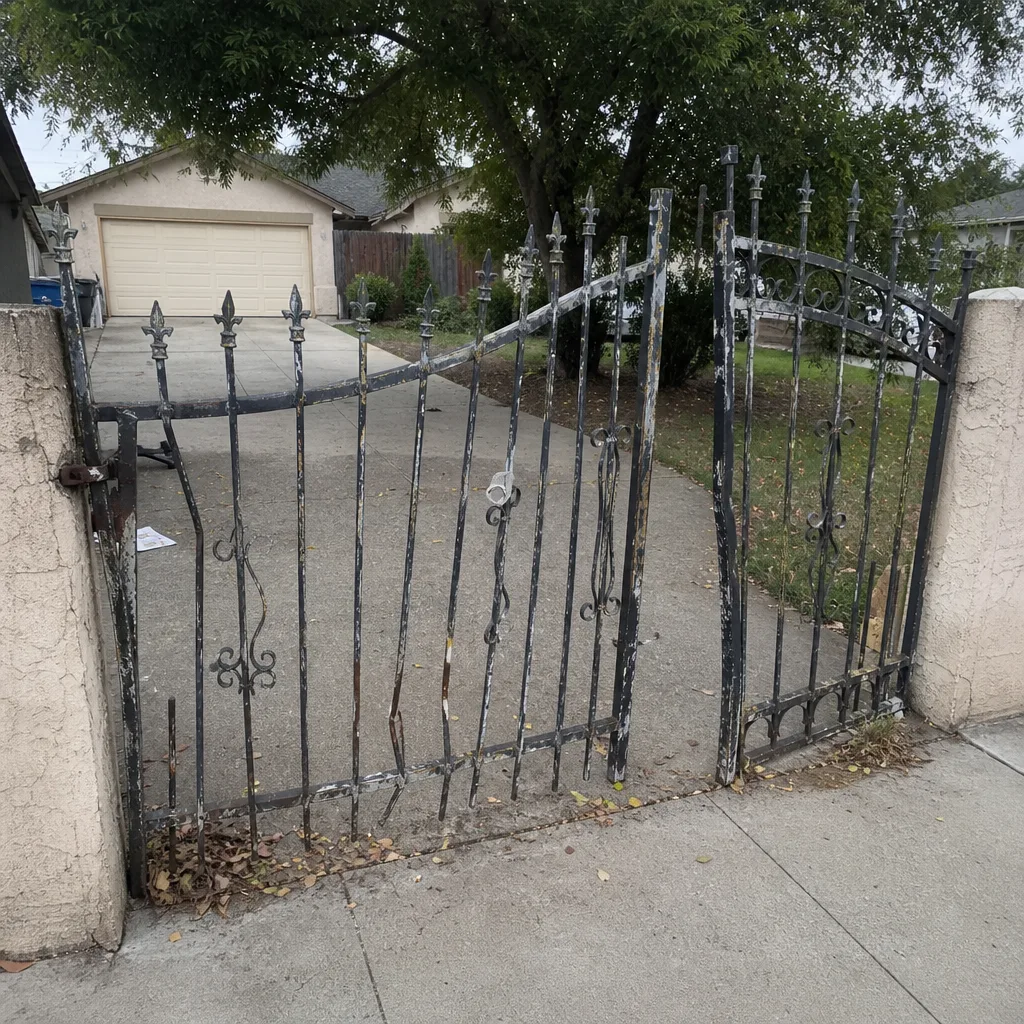 Before
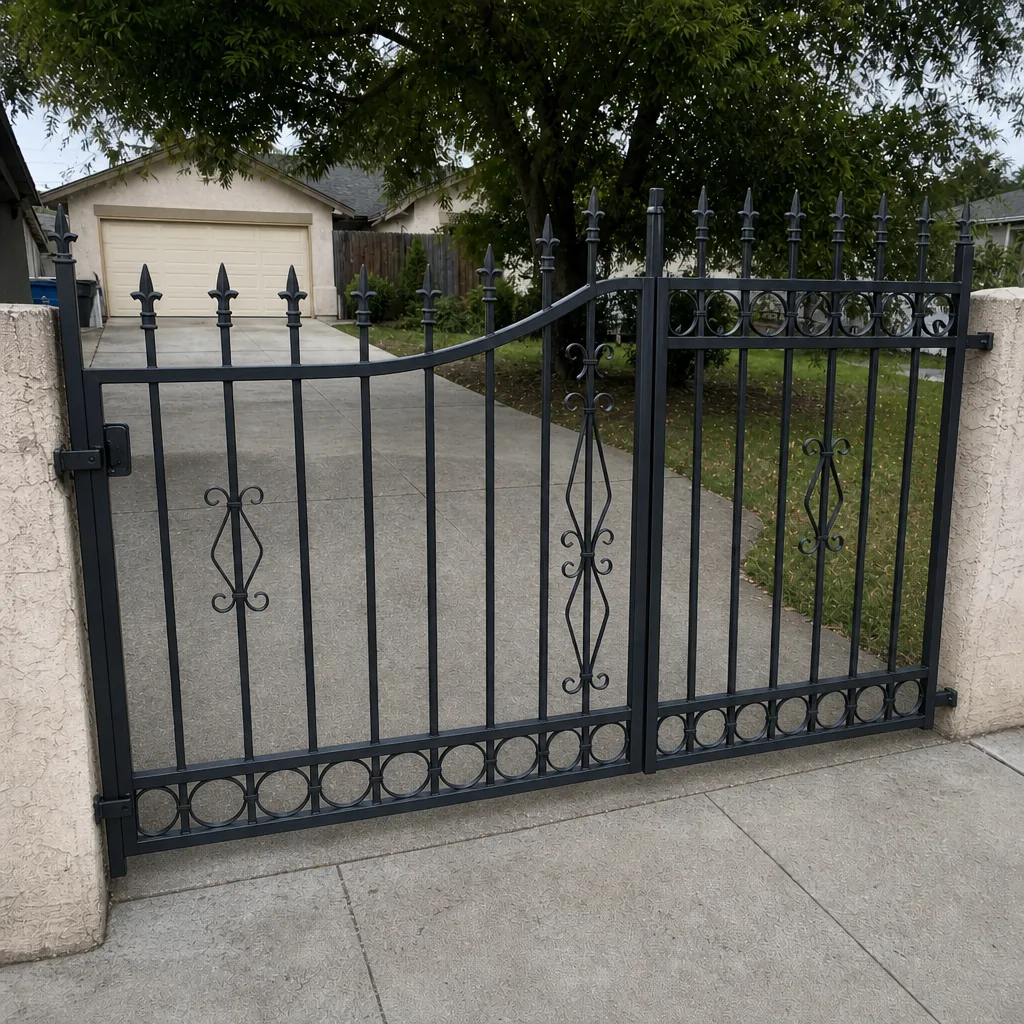 After
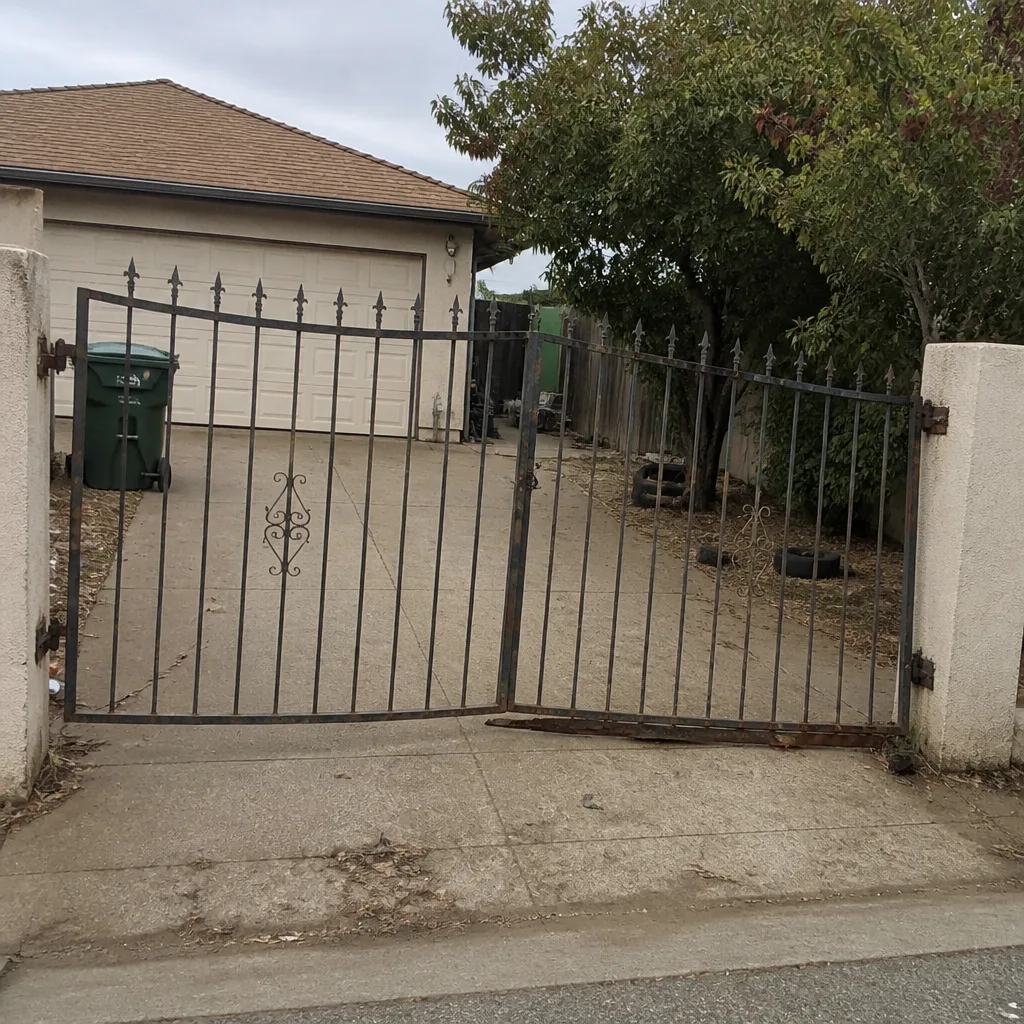 Before
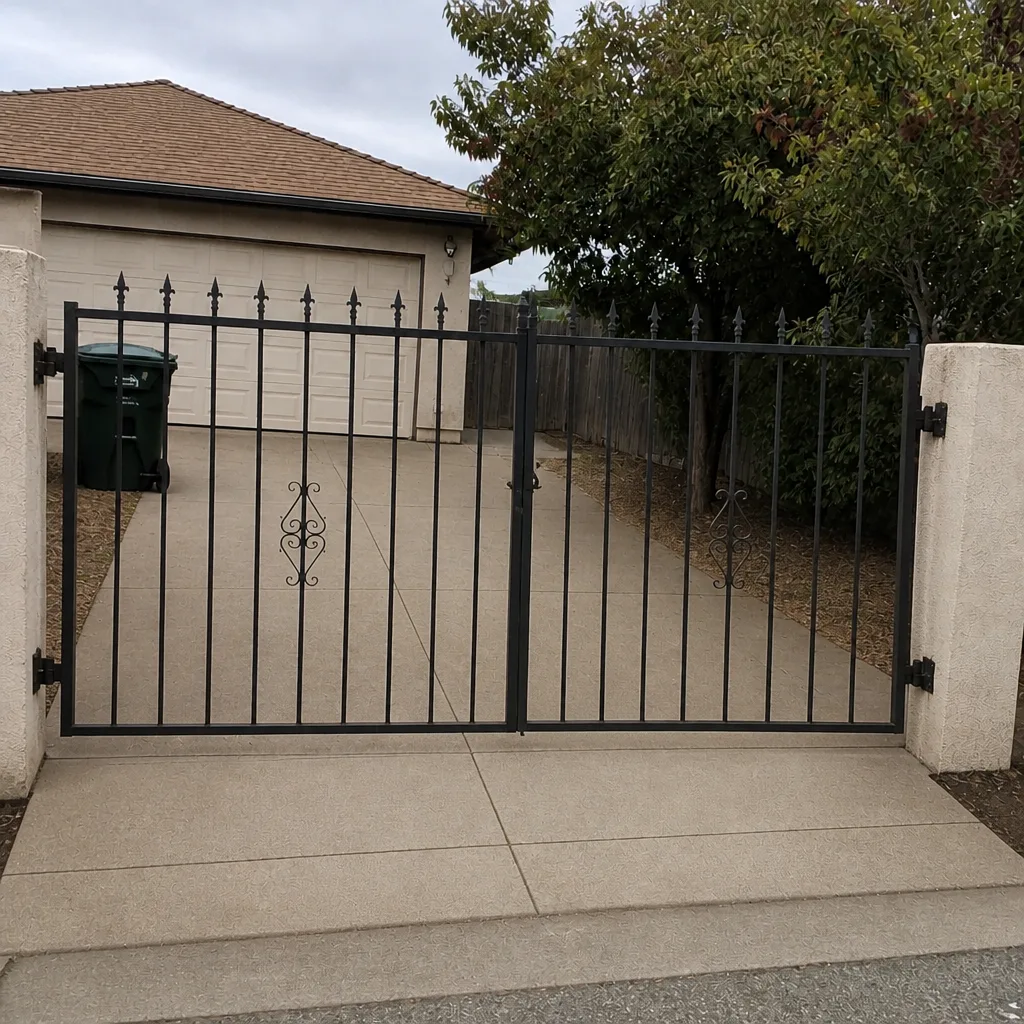 After
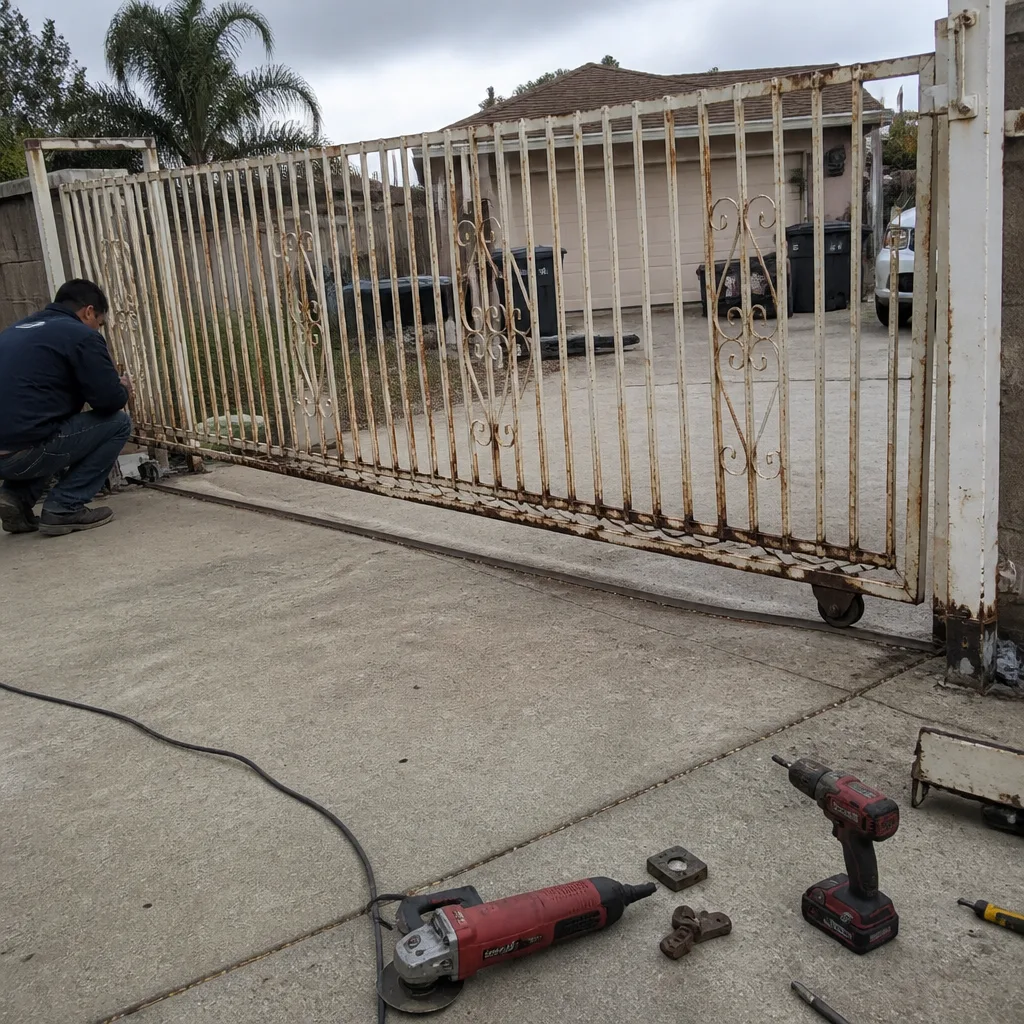 Before
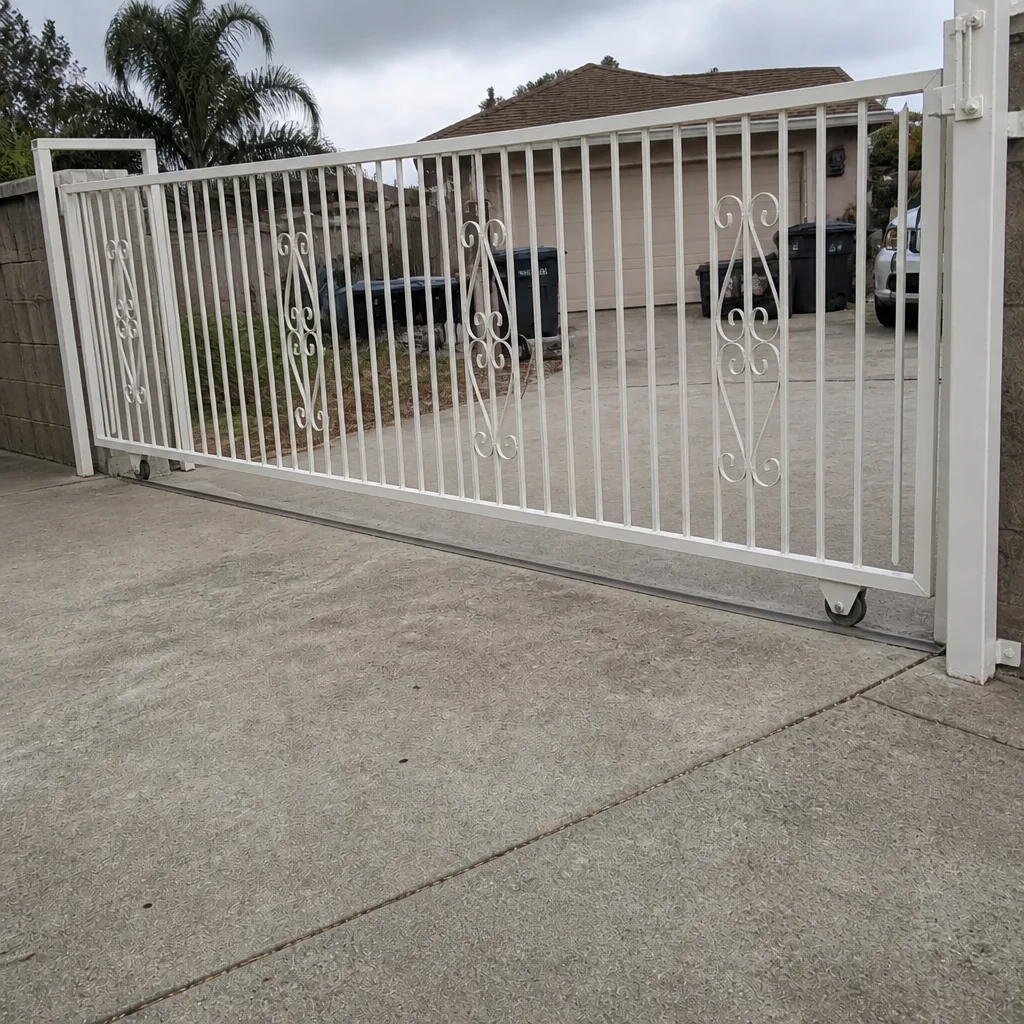 After
When to Call a Professional
Some maintenance belongs in your hands, and some doesn’t. Call a professional when the safety edge or loop detector tests fail, when the operator overheats or trips a breaker, when the gate stops in the same spot every cycle, when the manual release won’t move, when a hinge or track needs realignment, or when the gate has been struck and the frame or arm is bent. For any gate with electrical wiring or a high-torque operator, the safe move is to leave it to a trained technician – the moving mechanical parts and stored energy are a real hazard, and the safety systems aren’t something to test blind.
An electric gate specialist can trace the actual cause instead of guessing, and give you an honest call on repair versus replacement. We work on systems from Mighty Mule to FAAC. Our technicians have up to 15 years of experience across these systems. Gate Repair Tracy offers free estimates in Tracy – call (844) 834-1771. We answer 24/7. Fast dispatch from 7am to 7pm.
Frequently Asked Questions
Residential swing and slide gates should get a visual inspection monthly and a mechanical check every three months. Commercial barrier arms and high-cycle gates should be serviced more frequently – every one to two months, depending on cycle count. Seasonal torque and tension checks belong at the spring and fall temperature transitions.
You can lubricate hinges, pivot points, and chains yourself if you use the manufacturer’s specified lubricant. Do not add lubricant to a sealed gearbox or a hydraulic reservoir. If you’re not sure what your operator uses, check the manual or have a technician confirm it before you touch the can.
Start a close cycle and press the safety edge along its length. The gate should stop or reverse immediately at any point you press. If it only responds in one spot, or doesn’t reverse at all, the edge or its wiring needs attention from a professional.
Heat expands metal, changes chain tension, and can trip a thermal overload in the operator. Limit switches can also shift as temperatures rise. A seasonal tension and torque check is the most direct prevention.
First, clear any debris off the track and rollers. If it still drags, the track is likely out of alignment or a roller bearing is worn. That’s a track and roller issue, and it usually calls for a professional visit – continuing to run a dragging gate will wear the operator prematurely.
Call Gate Repair Tracy at (844) 834-1771. We handle repair, electric gate repair, and installation across the major system types. Estimates are free, and the price is set per job by a written estimate before work starts. We answer 24/7. Fast dispatch from 7am to 7pm.
The Bottom Line
The right maintenance checklist is built around what your gate actually is – swing, slide, or barrier arm – not what month it is. Hydraulic and electromechanical operators need different lubricants. Chain and belt drives need different tension checks. And two tests on every electric gate, the safety edge and the loop detector, should never be skipped. In our experience working Tracy gates, the systems that last are the ones with a written log, matched lubricants, and seasonal torque checks. If your gate needs a look, call Gate Repair Tracy at (844) 834-1771 for a free estimate. We answer 24/7. Fast dispatch from 7am to 7pm.
For an overview of everything we do, start with Gate Repair Tracy.
Written by the team at Gate Repair Tracy.